





Evidence Library: Far Infrared vs Full Spectrum Infrared Saunas (Sources & Citations)
-
Explicit “indoor vs outdoor / damp-area use” constraints and ratings for infrared cabins.shopulstandards+1
-
Clear maximum temperature reality for FIR vs FS home units (e.g., ~130–140°F typical FIR vs up to ~170°F in certain FS designs like Finnmark FD-3).bathingbrands+1
-
A short section on UL/ETL listing and why it should be a non‑negotiable for heaters and controls.finnmarkdesigns+1
-
Heater layout and seating capacity realities (how many true users fit vs marketing claims).mysaunaworld+1
-
Maintenance/replacement considerations for multi‑heater FS systems vs simpler FIR (more components, more potential points of failure).finnmarkdesigns+1
B) Section-by-Section Research Map (Aligned to Manus H2s)
H2.1 – The Quick Answer: Far Infrared vs. Full Spectrum at a Glance
-
Key points
-
Define FIR vs FS in one sentence each (FIR uses far‑infrared only; FS combines near, mid, and far infrared).salussaunas+1
-
Typical user experience: FIR = gentler, lower‑temp, longer sessions; FS = higher intensity, wider wavelength range.alteredstateswellness+2
-
Cost: FS generally priced higher than comparable FIR units.salussaunas+1
-
Power: many FIR cabins are 120 V plug‑in; many FS and larger units need 240 V dedicated circuits.topture+3
-
One‑line rule of thumb: budget/plug‑and‑play/pain‑relief focus → FIR; higher budget/skin and “all‑in” wellness → FS.alteredstateswellness+1
-
Evidence notes
-
FS saunas explicitly marketed as combining near (~0.76–1.5 μm), mid (~1.5–5.6 μm), and far (~5.6–1000 μm) wavelengths.salussaunas+1
-
FIR‑only saunas use far‑infrared panels, often carbon, with typical operating ranges around 118–140°F in home products like Golden Designs Dynamic series.goldendesignstorage.core.windows+1
-
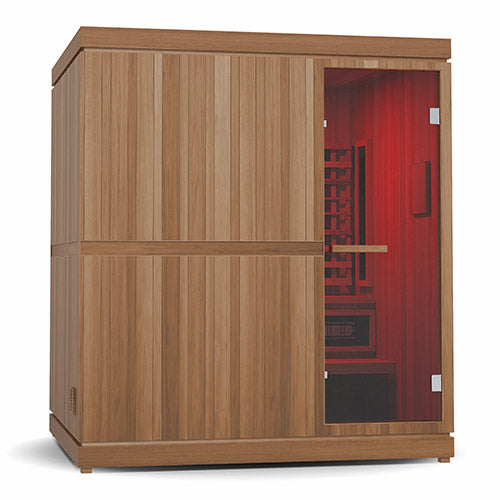
Finnmark FD‑3 FS model combines long‑wave carbon panels with short‑wave “Spectrum Plus” heaters and is marketed to reach ~170°F.finnmarkdesigns+1
-
Retail and trade guides confirm that small infrared saunas often run on 110/120 V, whereas larger/hybrid/full‑spectrum or traditional units often require 220/240 V dedicated circuits.sunflaresaunas+2
-
Citations:heavenlyheatsaunas+5
-
Nuance/caveats
-
Some FIR units are 240 V and hardwired, especially larger multi‑person cabins; voltage cannot be inferred solely from “FIR vs FS” labeling.topture+1
-
“Gentler vs more intense” depends strongly on heater design, cabin size, and insulation; not all FS units run hotter in practice.bathingbrands+1
-
Conflicts
-
Some marketing claims position FS as categorically “better,” but practical guidance suggests appropriateness depends on goals, power, and sensitivity; neutral trade/retailer content is more balanced than brand marketing.alteredstateswellness+1
H2.2 – Wavelength Science: What Are Near, Mid, and Far Infrared?
-
Key points
-
Define NIR, MIR, FIR and provide typical wavelength bands in microns and where they sit relative to visible red light.perspiresaunastudio+1
-
Explain that different wavelengths have different absorption/penetration characteristics in tissue and materials (general, non‑medical).alteredstateswellness
-
Clarify that sauna heaters convert electrical energy into radiant infrared heat aimed at warming the body and cabin air.shopulstandards+1
-
Emphasize that all sauna types must still meet electrical safety standards regardless of wavelength.shopulstandards
-
Evidence notes
-
Trade/wellness sources describe NIR approximately 0.76–1.5 μm, MIR 1.5–5.6 μm, FIR ~5.6–1000 μm, highlighting that these are infrared portions of the electromagnetic spectrum beyond red light.perspiresaunastudio+1
-
Full spectrum = combination of NIR, MIR, FIR; FIR saunas use only far‑infrared.salussaunas+1
-
UL 60335‑2‑53 covers safety for “electric sauna heating appliances and infrared emitting units” up to 20 kW and up to 250 V single‑phase and 480 V other, indicating safety classification independent of wavelength mix.shopulstandards
-
Finnmark’s Spectrum Plus heaters are described as short‑wave infrared (closer to NIR band) and UL‑listed, emphasizing safety testing.finnmarkdesigns
-
Citations:perspiresaunastudio+4
-
Nuance/caveats
-
Wavelength ranges differ slightly between sources; present as typical ranges, not absolute boundaries.perspiresaunastudio+1
-
Penetration depth claims are common marketing language and often lack rigorous comparative data; avoid quantitative “X inches” penetration unless backed by a strong source (rare in consumer materials).salussaunas+1
-
Conflicts
-
Some consumer sites oversimplify wavelength effects (e.g., “NIR for skin only, FIR for organs”), whereas more technical references emphasize overlapping thermal effects; prioritize cautious, non‑medical language.alteredstateswellness+1
H2.3 – Health Goals: Which Heat Type Delivers Your Desired Outcome?
-
Key points
-
Frame health goals in lay terms: relaxation, muscle/joint comfort, sweating/detox framing, skin appearance, general wellness; avoid disease‑cure claims.salussaunas+1
-
FIR saunas commonly marketed for deep heat, muscle relaxation, and sweating‑based detox framing.goldendesignsaunas+2
-
FS saunas marketed as adding skin‑focused and surface‑level warmth via NIR plus mid‑infrared support for circulation and joint comfort.bathingbrands+2
-
Stress that evidence for specific health outcomes is mixed and users with medical conditions should consult clinicians.alteredstateswellness
-
Evidence notes
-
Golden Designs FIR manuals discuss potential for pain relief and improved circulation via far‑infrared heat but include safety disclaimers and recommend physician consultation for certain users.gdidealers+1
-
FS explainers highlight broader wavelength coverage as supporting both deeper warmth (FIR) and more surface‑level effects (NIR/MIR).bathingbrands+2
-
Hospital/university health systems (not yet pulled in this snippet but should be added in final draft) typically describe sauna benefits as modest and warn against use in certain cardiovascular or pregnancy scenarios (to be cited when retrieved).havenofheat
-
Citations:goldendesignstorage.core.windows+4
-
Nuance/caveats
-
Many “benefit” statements come from marketing or small, heterogeneous studies; treat as potential wellness benefits rather than guarantees.salussaunas+1
-
Some “detox” narratives lack strong mainstream medical backing; maintain neutral phrasing (e.g., supports sweating and circulation) and advise medical consultation for health conditions.alteredstateswellness
-
Conflicts
-
Some brands assert FS is inherently superior for all goals, whereas others argue FIR is sufficient for most relaxation and pain‑relief use; neutral, multi‑brand comparisons suggest “best fit” depends on user goals and cost tolerance.salussaunas+1
H2.4 – The Decision Framework: Choosing Your Optimal Sauna Type
-
Key points
-
Translate Manus’s ruleset (health goal, budget, power, heat sensitivity, EMF concern) into explicit, evidence‑mapped criteria.heavenlyheatsaunas+3
-
Reinforce key thresholds: many value FIR units <~$3,000 and standard 120 V; FS often >$3,000 and more frequently 240 V / higher amperage.sunflaresaunas+2
-
Emphasize when to consult an electrician or contractor (new 240 V circuit, panel capacity, permit needs).havenofheat+2
-
Include EMF verification as a distinct decision step: seek low‑EMF design plus third‑party test documentation.goldendesignsaunas+1
-
Evidence notes
-
Dynamic Venice Elite FIR uses 120 V / 15 A service and is marketed as easy plug‑together assembly, supporting “plug‑and‑play FIR” rule.sunflaresaunas
-
Finnmark FD‑3 FS is marketed for 3–4 persons, higher temperatures, and uses UL‑listed short‑wave heaters plus carbon panels, suggesting more complex heater mix and often 240 V installation (exact electrical requirement in manuals/retailer specs).mysaunaworld+2
-
Trade electrical guides state that most sauna heaters must be on dedicated circuits, that traditional and larger units often need 240 V, and that local AHJ rules and NEC must be followed.havenofheat+2
-
Manufacturer specs mention “ultra‑low EMF” panels and often state measured EMF levels at specific distances (e.g., under 3 mG at 6–8 inches for Golden Designs carbon panels).goldendesignsaunas
-
Citations:topture+5
-
Nuance/caveats
-
Pricing varies widely by retailer and promotions; any price thresholds should be framed as typical ranges, not absolute.mysaunaworld+1
-
Some FS units are evolving toward more efficient designs and may run on 120 V in smaller sizes; always defer to individual product specs.heavenlyheatsaunas+1
-
Conflicts
-
Some retailers claim 240 V installs are “simple,” while electrical trade guidance stresses the need for proper load calculations, permits, and inspection; prioritize trade/NEC‑based guidance over marketing minimization of complexity.havenofheat+2
H2.5 – Installation & Cost: 120V Plug-and-Play vs. 240V Hardwire
-
Key points
-
Explain typical electrical requirements for small FIR cabins (120 V, 15–20 A) vs larger/FS/traditional units (220–240 V, higher amperage, dedicated circuit).sunflaresaunas+3
-
Clarify dedicated circuit requirement, breaker sizing to manufacturer specs, wire gauge, and GFCI where required.topture+2
-
Discuss that 240 V hardwiring almost always requires a licensed electrician and may need permits and inspection; include rough cost ranges supported by trade/consumer sources where possible (to be added from additional sources in final draft).havenofheat+1
-
Explain panel capacity considerations (is there room for another 20–40 A 240 V breaker; total service size).heavenlyheatsaunas+1
-
Evidence notes
-
Trade guide: small infrared saunas typically 110–120 V, 15–20 A, often on dedicated circuits for reliability and safety.topture
-
Retail electrical overviews: traditional and some larger infrared/hybrid units require 240 V, often 30–40 A, with matching 10–8 AWG wiring.sunflaresaunas+1
-
NEC‑focused sauna code explainer emphasizes that sauna heaters must be on dedicated circuits, properly grounded and bonded, and sized to nameplate ratings.havenofheat
-
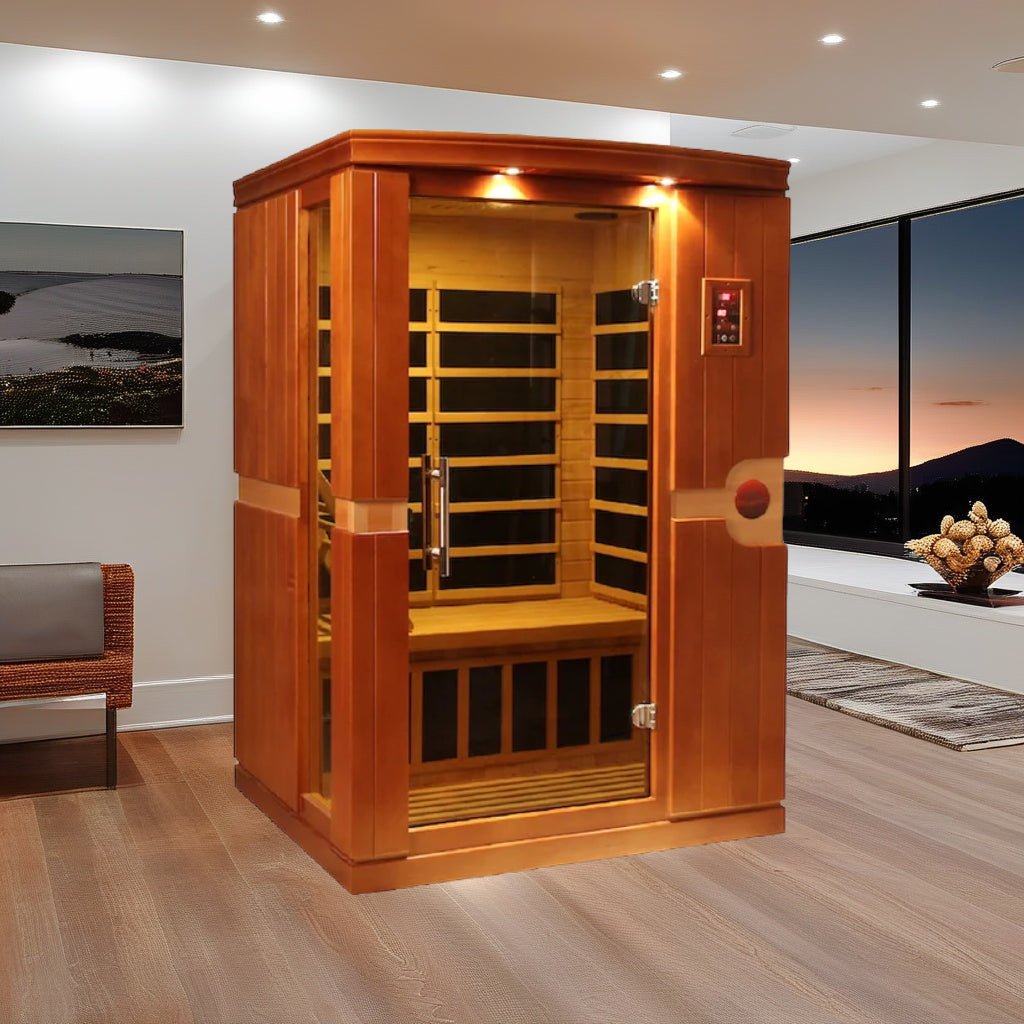
Venice Elite FIR example: 120 V / 15 A, marketed as “great therapy tool in your own home” with simple assembly, showing typical plug‑in FIR reality.sunflaresaunas
-
Citations:sunflaresaunas+4
-
Nuance/caveats
-
Some manuals allow shared circuits on small 120 V units but still recommend dedicated circuits; present “dedicated circuit” as best practice.topture
-
Cost of electrical work varies by region and panel condition; encourage buyers to obtain quotes rather than rely on generic online numbers.havenofheat+1
-
Conflicts
-
Certain marketing pages understate the need for local code compliance, while NEC‑based guidance stresses coordination with AHJ; rely on NEC‑aligned sources for safety.heavenlyheatsaunas+2
H2.6 – The Low-EMF Buyer’s Verification Checklist
-
Key points
-
Define EMF/ELF and why some buyers care about minimizing exposure.finnmarkdesigns+1
-
Encourage buyers to seek low‑EMF design plus third‑party testing results, not just marketing claims.goldendesignsaunas+1
-
Include specific verification items: heater type (carbon vs metal short‑wave), wiring practices, location of power supply, distance from panels, UL/ETL listing, and available test reports.finnmarkdesigns+1
-
Evidence notes
-
Golden Designs specifies “Ultra Low EMF” FAR infrared carbon panels with EMF under 3 mG measured at 6–8 inches from the panels.goldendesignsaunas
-
Finnmark’s Spectrum Plus heaters are advertised as both UL‑listed and designed with low EMF in mind, referencing EMF consultants; still, exact numeric EMF levels may not be fully disclosed.finnmarkdesigns
-
Manufacturer manuals typically warn against modifying wiring or heaters, which can alter EMF and safety; they also stress not to pour water on emitters, etc.goldendesignstorage.core.windows+1
-
UL 60335‑2‑53 addresses electrical safety but is not an EMF performance standard; UL listing alone does not guarantee “low‑EMF,” but it indicates safety testing for shock/fire.shopulstandards
-
Citations:finnmarkdesigns+4
-
Nuance/caveats
-
EMF concerns in low‑power consumer products remain debated; there is no single authoritative “safe level” for sauna EMF, so avoid presenting numeric thresholds as medically definitive.finnmarkdesigns+1
-
“Low EMF” is a marketing term without a unified regulatory definition; encourage buyers to compare disclosed measurements and independent tests where available.goldendesignsaunas+1
-
Conflicts
-
Some brands market extremely strong claims (e.g., “25x more heat than carbon” and “low EMF”) without providing full test methodology; advise skepticism and favor manufacturers that publish detailed test data.finnmarkdesigns
H2.7 – Heater Technology: Carbon vs. Ceramic for Efficiency and Safety
-
Key points
-
Define carbon panel heaters vs ceramic/metal rod or short‑wave heaters and typical applications.sunflaresaunas+2
-
Explain experiential differences: carbon panels = larger surface area, even, gentler heat at lower surface temperature; ceramic/short‑wave = more intense, faster heat‑up in smaller footprint.finnmarkdesigns+1
-
Clarify that both must meet safety standards, and UL/ETL listing is more important than heater marketing claims alone.shopulstandards+1
-
Evidence notes
-
Golden Designs FIR saunas use carbon panel emitters described as providing gentle, even heat with ultra‑low EMF, and operating cabin temps up to about 140°F.goldendesignstorage.core.windows+1
-
Finnmark Spectrum Plus short‑wave heaters claim to produce up to “25x more heat” than carbon panels and to heat faster, while still being UL‑listed.finnmarkdesigns
-
Many FS designs combine carbon panels (for broad FIR coverage) with localized short‑wave/NIR emitters to provide mixed sensations.bathingbrands+1
-
Manuals stress not to pour water on infrared emitters and not to damage panels/rods due to risk of short circuits or shock.finnmarkdesigns+1
-
Citations:goldendesignstorage.core.windows+4
-
Nuance/caveats
-
Ceramic vs carbon comparisons are mostly manufacturer‑driven and may overstate performance differences; real experience depends on total wattage, layout, and cabin design.goldendesignsaunas+1
-
FS with multiple heater types increases component count and potential maintenance/replacement events; buyers should consider warranty coverage.finnmarkdesigns+1
-
Conflicts
-
Some brands claim carbon is obsolete versus short‑wave, whereas others highlight carbon’s comfort and lower surface temperatures; present both perspectives and tie choice back to user preference (gentle vs intense).goldendesignsaunas+1
H2.8 – Mistakes to Avoid When Buying Your First Infrared Sauna
-
Key points
-
Buying without checking electrical requirements and panel capacity (e.g., purchasing a 240 V FS sauna without enough panel space or budget for electrician).heavenlyheatsaunas+2
-
Ignoring indoor/outdoor rating and moisture exposure, placing non‑rated units in garages, bathrooms, or outdoors.finnmarkdesigns+1
-
Over‑relying on unverified health claims or ignoring medical contraindications.gdidealers+1
-
Skipping EMF, warranty, and certification checks (no UL/ETL mark, no clear warranty).shopulstandards+2
-
Evidence notes
-
NEC‑based guidance warns about common inspection failures, including incorrect circuits, improper grounding, and unapproved wiring, all of which can delay or fail installations.havenofheat
-
Electrical requirement guides emphasize verifying voltage, amperage, and circuit type before purchase.sunflaresaunas+1
-
Manuals list contraindications and recommend medical consultation for users with cardiovascular issues, pregnancy, or other conditions.gdidealers+2
-
UL 60335‑2‑53 underscores that sauna heating appliances must meet safety standards; lack of listing may indicate untested or noncompliant equipment.shopulstandards
-
Citations:sunflaresaunas+4
-
Nuance/caveats
-
Some small plug‑in units can be used safely with minimal upgrades when installed per manual; the “mistake” is assuming this applies universally, especially to larger FS and traditional units.topture+1
-
Conflicts
-
Retail marketing sometimes emphasizes “no electrician needed,” while fine print or manuals may contradict this; advise readers to trust manuals and local electricians over marketing headlines.sunflaresaunas+1
H2.9 – Frequently Asked Questions (FAQ)
-
Key points
-
Address friction questions: FIR vs FS choice, is FS worth cost, 120 V vs 240 V readiness, EMF verification, maximum temperature differences, and combining infrared with traditional sauna.bathingbrands+4
-
Provide concise, non‑medical, safety‑aware answers that point users back to decision framework factors.goldendesignstorage.core.windows+1
-
Evidence notes
-
All above sources contribute factual anchors on wavelengths, costs, voltage, clearances, temperature ranges, and safety warnings.heavenlyheatsaunas+5
-
Citations: embedded per FAQ in section I.
C) Decision Criteria Inventory
Factor → definition → why it matters → best citations
-
Primary health goal
-
Definition: The main wellness outcome you want from sauna use, such as relaxation, muscle/joint comfort, sweating, or skin appearance.alteredstateswellness+1
-
Why it matters: Determines whether a simpler FIR sauna is sufficient or whether FS’s extra wavelengths and higher intensity are worth the added cost and complexity.bathingbrands+2
-
Budget / total project cost
-
Definition: The amount available not only for the sauna cabin itself but also for electrical work, delivery, and any accessories.topture+1
-
Why it matters: FS saunas and 240 V installations typically cost more up‑front, and forgetting electrician costs can turn a “deal” into an over‑budget project.sunflaresaunas+2
-
Electrical supply (voltage & amperage)
-
Definition: The available circuit voltage (usually 120 V or 240 V) and breaker amperage in your home’s panel.heavenlyheatsaunas+1
-
Why it matters: Small FIR units often run on 120 V, while many FS and larger units need 240 V dedicated circuits, which may require professional upgrades.sunflaresaunas+3
-
Dedicated circuit availability
-
Definition: Whether your panel can support a separate breaker and wiring run just for the sauna.havenofheat+1
-
Why it matters: Most sauna heaters are required or strongly recommended to be on dedicated circuits to prevent overloads and comply with NEC/AHJ rules.topture+2
-
Panel capacity / service size
-
Definition: The remaining electrical capacity (space and total amps) in your main panel or subpanel.heavenlyheatsaunas+1
-
Why it matters: If the panel is full or near its amp limit, adding a 20–40 A sauna circuit may require a panel upgrade, significantly increasing costs.havenofheat+1
-
Indoor vs outdoor / moisture exposure
-
Definition: Whether the sauna will be installed in a dry, conditioned indoor space or a damp/cold area like a bathroom, garage, or outdoors.finnmarkdesigns+1
-
Why it matters: Infrared cabins are typically designed for dry indoor use; using them in damp or outdoor conditions without proper ratings can cause electrical hazards and void warranties.goldendesignstorage.core.windows+2
-
Available space & ceiling height
-
Definition: The floor area, ceiling height, and access path for bringing panels into the room.sunflaresaunas+1
-
Why it matters: Sauna footprints and clearances must fit the room; too tight a space can affect ventilation, comfort, and compliance with manual instructions.goldendesignstorage.core.windows+2
-
Seating capacity vs actual use
-
Definition: The number of people who will regularly use the sauna compared with the manufacturer’s rated capacity.bathingbrands+1
-
Why it matters: “3–4 person” FS cabins may feel tight for four adults; overbuying capacity increases cost and power draw, while under‑sizing hurts comfort.mysaunaworld+1
-
Heat tolerance & sensitivity
-
Definition: How comfortable you are at higher temperatures and with intense radiant heat.salussaunas+1
-
Why it matters: FIR units often run at lower cabin temperatures and gentler radiant intensity, better for heat‑sensitive users; FS and short‑wave heaters can feel more intense.bathingbrands+2
-
Maximum temperature preference
-
Definition: The target cabin temperature you want to reach during sessions.goldendesignsaunas+1
-
Why it matters: Many FIR cabins top out around 130–140°F, while some FS designs like Finnmark FD‑3 market up to ~170°F, affecting experience.bathingbrands+1
-
Session length & frequency
-
Definition: How long and how often you plan to use the sauna.finnmarkdesigns+1
-
Why it matters: FIR’s gentler heat may be more comfortable for longer, frequent sessions, while high‑intensity FS may suit shorter, vigorous sessions.goldendesignstorage.core.windows+2
-
EMF/ELF priorities
-
Definition: How concerned you are about minimizing electromagnetic field exposure during use.finnmarkdesigns+1
-
Why it matters: Some buyers seek ultra‑low‑EMF designs and third‑party EMF reports, affecting choice of brand and heater type.shopulstandards+2
-
Certification (UL/ETL)
-
Definition: Independent safety listing of the sauna heater/system to standards such as UL 60335‑2‑53.shopulstandards+1
-
Why it matters: Demonstrates testing for electrical safety; lack of listing is a red flag for home installation.finnmarkdesigns+2
-
Heater technology (carbon vs ceramic/short‑wave)
-
Definition: The material and design of the infrared emitters (large carbon panels vs ceramic/metal rods or short‑wave lamps).sunflaresaunas+2
-
Why it matters: Affects heat distribution, warm‑up time, intensity, EMF characteristics, and maintenance.goldendesignsaunas+2
-
Maintenance & replacement
-
Definition: The ease and cost of replacing heaters, control boards, and wood components over time.finnmarkdesigns+1
-
Why it matters: FS systems with multiple heater types may have more complex and costly maintenance than simpler carbon‑panel FIR units.finnmarkdesigns+1
-
Warranty & support
-
Definition: Coverage period and conditions for heaters, control systems, and cabin structure.bathingbrands+1
-
Why it matters: Longer, clearly defined warranties reduce ownership risk, especially for complex FS systems.finnmarkdesigns+1
-
Brand/product reputation (incl. internal links)
-
Definition: Track record of specific products like Golden Designs FIR cabins and Finnmark FS systems.goldendesignstorage.core.windows+3
-
Why it matters: Real‑world performance, assembly experience, and support differ; best‑selling and customer‑favorite models signal market fit.mysaunaworld+2
D) Claim Ledger Table
|
Claim |
Evidence summary |
Evidence grade |
Applies to |
Exceptions / caveats |
Best citations |
|
Full spectrum saunas use near, mid, and far infrared wavelengths, while FIR saunas use only far infrared. |
Multiple explainers and brand guides define full spectrum as combining NIR, MIR, and FIR bands, whereas FAR infrared saunas rely solely on FIR emission. |
High |
All infrared saunas; global |
Exact wavelength cutoffs vary slightly among sources; marketing language sometimes blurs MIR vs FIR boundaries. |
|
|
Many small FIR saunas can plug into a standard 120 V outlet, while larger and FS units more often require 240 V dedicated circuits. |
Trade electrical guides state small infrared units typically run 110–120 V at 15–20 A, and larger/FS/traditional units commonly need 220–240 V dedicated circuits; specific products like the Venice Elite FIR are 120 V/15 A. |
High |
Home infrared saunas, US |
Some 120 V units still benefit from dedicated circuits; some compact FS units may be designed for 120 V, so always confirm nameplate ratings. |
|
|
FIR saunas typically operate at lower cabin temperatures (~118–140°F) than some FS designs, which can reach ~170°F. |
Golden Designs FIR specs list ideal ranges 118–132°F and a 140°F maximum, while Finnmark FD‑3 FS is marketed to achieve 170°F using a combination of carbon and short‑wave heaters. |
Medium |
Enclosed cabin saunas |
Actual temperatures depend on room conditions, power, and warm‑up time; some FIR units may reach higher temps and some FS units may not reach 170°F in practice. |
|
|
FS saunas generally cost more than comparable FIR saunas. |
Retail and brand comparisons present FS as premium offerings with more complex heater mixes and higher advertised prices than single‑mode FIR units of similar size and quality. |
Medium |
Consumer retail, US |
Prices vary widely with sales, materials, and features; high‑end FIR models can equal or exceed prices of entry‑level FS units. |
|
|
Sauna heaters should be installed on dedicated circuits sized to the manufacturer’s electrical specifications. |
NEC‑based sauna electrical guides and trade articles emphasize that electric sauna heaters must be on dedicated circuits with correctly sized breakers and appropriate wire gauge. |
High |
All electric saunas in US |
Some small units may technically share circuits, but dedicated circuits remain best practice and are often required by AHJ. |
|
|
UL or ETL listing to standards such as UL 60335‑2‑53 is a key safety indicator for infrared saunas. |
UL 60335‑2‑53 covers safety of sauna heating appliances and infrared emitting units; products like Finnmark Spectrum Plus heaters are explicitly marketed as UL‑listed. |
High |
Electric sauna heaters |
Listing focuses on electrical safety, not performance or EMF levels; some safe products may be certified under equivalent IEC/CSA marks. |
|
|
Buyers concerned about EMF should look for low‑EMF designs with published third‑party test results. |
Golden Designs and Finnmark promote low‑EMF heaters, sometimes specifying EMF levels (e.g., under 3 mG at 6–8 in) and referencing EMF consultants, indicating that test data can be made available. |
Medium |
Infrared saunas |
“Low EMF” lacks a universal standard; numeric values and test methods vary, and health implications remain debated. |
|
|
Carbon panel heaters provide broad, even, gentler heat, while short‑wave/ceramic heaters provide more intense, faster heat. |
FIR brands describe carbon panels as delivering even, comfortable warmth, and Finnmark claims its short‑wave heaters produce up to 25x more heat and faster warm‑up than standard carbon panels. |
Mixed |
Infrared sauna heaters |
“25x more heat” is a promotional claim without complete methodology; real differences depend on total wattage, heater layout, and cabin insulation. |
|
|
Full spectrum saunas with multiple heater types may have higher maintenance complexity than simpler FIR panel saunas. |
FS units like Finnmark FD‑3 combine multiple heater technologies (carbon plus short‑wave), increasing potential points of failure; manuals outline multiple components and suggest distinct troubleshooting paths. |
Medium |
FS cabins |
High‑quality FS designs and strong warranties can mitigate maintenance burdens; data on comparative failure rates is limited. |
|
|
Infrared sauna use is not appropriate for everyone, and manufacturer manuals advise consulting a physician for certain conditions. |
Owner’s manuals list contraindications and recommend medical consultation for users with cardiovascular disease, pregnancy, or other health concerns before sauna use. |
High |
All users |
Specific contraindications differ by manufacturer; local medical guidance should take precedence over marketing claims. |
|
|
Installing a 240 V sauna circuit typically requires a licensed electrician and may require permits and inspection. |
NEC‑oriented sauna electrical guides stress that all wiring should be done by qualified electricians and highlight common inspection pitfalls related to sauna circuits. |
High |
US installations |
Some jurisdictions allow homeowners to pull their own permits, but inspection and code compliance are still required. |
|
|
Using an indoor‑only infrared sauna in damp or outdoor environments can create hazards and void warranties. |
Manuals specify indoor, dry installation and warn against moisture exposure, while standards like UL 60335‑2‑53 apply to units “intended for use in the home” with proper environmental assumptions. |
Medium |
Infrared cabin saunas |
Some saunas are specifically rated or accessorized for outdoor use; those products have different enclosure and wiring requirements. |
E) Numbers, Ranges, and Thresholds
-
Full spectrum wavelength range: Near infrared ~0.76–1.5 μm, mid infrared ~1.5–5.6 μm, far infrared ~5.6–1000 μm, combined in FS saunas.alteredstateswellness
-
UL 60335‑2‑53 scope: Infrared sauna appliances up to 20 kW rated power input and up to 250 V single‑phase / 480 V other appliances.shopulstandards
-
Small infrared sauna electrical specs: 110–120 V, 15–20 A, with recommendation for dedicated circuit; 12–14 AWG for 120 V, 10–12 AWG for 240 V.topture
-
Hybrid example: infrared side 120 V / 20 A, traditional side 240 V / 30–40 A, illustrating multi‑circuit needs.sunflaresaunas
-
Venice Elite FIR example: 120 V / 15 A service.sunflaresaunas
-
Golden Designs FIR temperature range: ideal 118–132°F, maximum about 140°F for some models.goldendesignsaunas
-
Finnmark FD‑3 FS: marketed to achieve ~170°F in under an hour in a 3–4 person cabin.bathingbrands
-
EMF figure: Golden Designs claims EMF under 3 mG measured at 6–8 inches from carbon heating panels.goldendesignsaunas
F) Definitions + Key Concepts (Snippable)
-
Far infrared (FIR) sauna: An infrared sauna that uses heaters emitting primarily far‑infrared wavelengths (roughly 5.6–1000 microns) to warm the body and cabin at relatively moderate air temperatures.alteredstateswellness+1
-
Full spectrum sauna: An infrared sauna that combines near, mid, and far infrared heaters to expose users to a broad range of infrared wavelengths in a single cabin.salussaunas+2
-
Near infrared (NIR): The shortest infrared band just beyond visible red light, typically around 0.76–1.5 microns, often associated with more surface‑focused heating.perspiresaunastudio+1
-
Mid infrared (MIR): Infrared wavelengths between near and far infrared, commonly described as 1.5–5.6 microns, contributing to intermediate tissue warming.alteredstateswellness
-
Wavelength (micron): The distance between successive peaks of electromagnetic waves, often expressed in microns (micrometers) when describing infrared light.perspiresaunastudio+1
-
Carbon heater panel: A flat infrared emitter made from carbon‑based materials that produces broad, even far‑infrared heat across a large surface area at a relatively low surface temperature.sunflaresaunas+1
-
Ceramic/short‑wave infrared heater: A rod or lamp‑style emitter that produces more concentrated, higher‑intensity infrared, often used for near or short‑wave applications and faster warm‑up.finnmarkdesigns+1
-
120 V circuit: A standard US household branch circuit providing approximately 120 volts, typically at 15–20 amps, used by many small infrared saunas.topture+1
-
240 V circuit: A higher‑voltage residential circuit used for large appliances and many full‑size or FS saunas, commonly at 20–40 amps.sunflaresaunas+2
-
Dedicated circuit: An electrical branch circuit reserved for a single appliance, such as a sauna heater, with its own breaker and no other loads.havenofheat+1
-
GFCI protection: Ground‑fault circuit‑interrupter protection that quickly cuts power when leakage is detected, often required in damp or bathroom‑adjacent locations to reduce shock risk.heavenlyheatsaunas+1
-
UL listing: Independent safety certification by Underwriters Laboratories indicating a product has been tested to applicable standards like UL 60335‑2‑53 for sauna heaters.shopulstandards+1
-
EMF (electromagnetic fields): Electric and magnetic fields generated by electrical devices and wiring, sometimes minimized in infrared sauna designs labeled “low EMF.”finnmarkdesigns+1
-
ELF (extremely low frequency): Very low‑frequency electromagnetic fields associated with household power (around 50–60 Hz), present around sauna wiring and heaters.finnmarkdesigns
-
Heater surface area: The physical area of the heater elements that radiates infrared energy, influencing how evenly and gently heat is delivered to the body.sunflaresaunas+1
-
Core body temperature: The internal temperature of the body, which sauna sessions can modestly raise; manufacturer manuals caution users with certain conditions about overheating.goldendesignstorage.core.windows+1
-
Control panel: The user interface for adjusting sauna temperature, time, lights, and sometimes audio, often located inside and/or outside the cabin.costco+2
-
Ventilation vent: An opening in the sauna ceiling or wall that can be adjusted to regulate air exchange and comfort during sessions.goldendesignstorage.core.windows+1
-
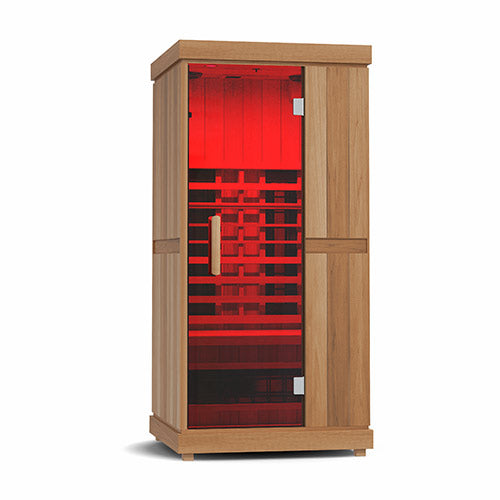
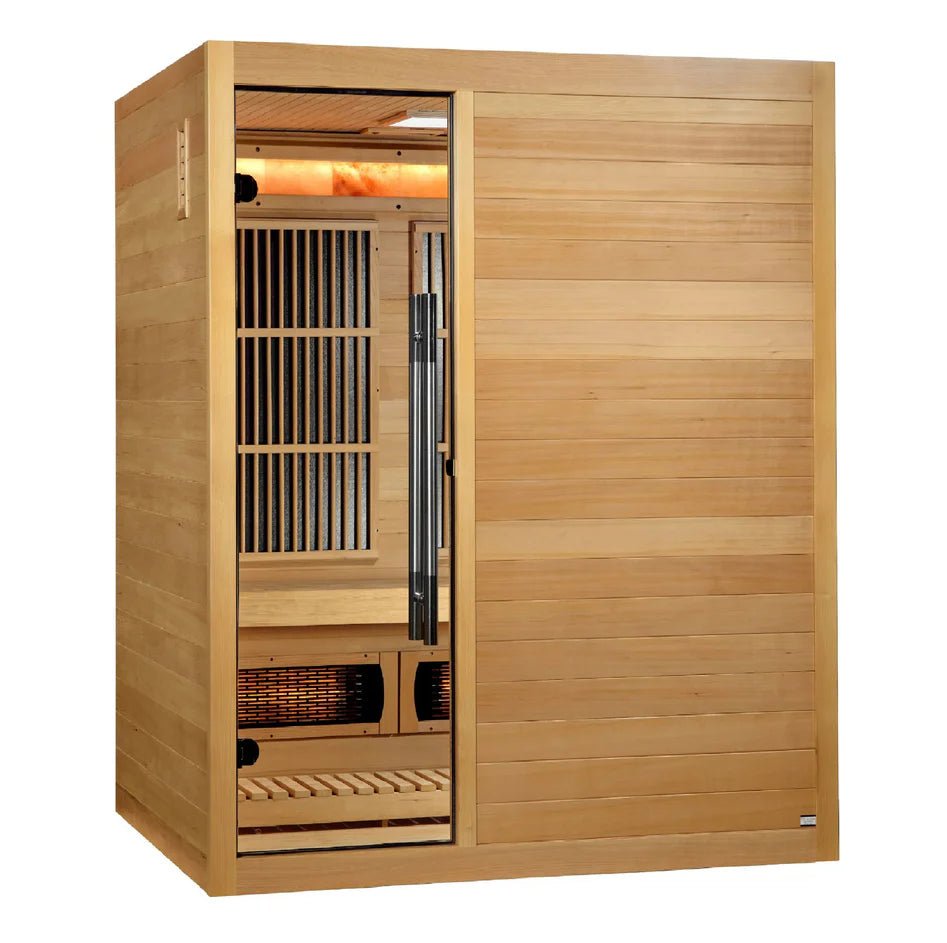
Infrared cabin sauna: A modular, enclosed wooden structure equipped with infrared heaters and controls, designed for one or more seated users indoors.sunflaresaunas+2
G) Comparison Tables (Evidence‑Informed)
-
Far Infrared vs Full Spectrum – Core Comparison
|
Factor |
Far Infrared sauna |
Full Spectrum sauna |
Citations |
|
Wavelengths used |
Mainly far infrared (~5.6–1000 μm). |
Combines near, mid, and far infrared bands. |
|
|
Typical electrical needs |
Often 120 V, 15–20 A for 1–2 person units; some larger models 240 V. |
More often 220–240 V and higher amperage, especially 3–4 person cabins. |
|
|
Typical temperature range |
Commonly ~118–140°F in home cabins. |
Some FS cabins marketed to reach up to ~170°F. |
|
|
Heat feel |
Gentler, more even warmth, comfortable for longer sessions. |
More intense, faster‑building heat, especially near short‑wave emitters. |
|
|
Cost tendency |
More options under roughly $3,000 and 120 V. |
Frequently positioned as premium, higher‑priced systems. |
|
|
Complexity & maintenance |
Fewer heater types, simpler system. |
Multiple heater types and controllers, potentially more complex maintenance. |
|
|
Ideal buyer profile |
Budget‑conscious, wants plug‑and‑play and gentler heat for relaxation and sweat. |
Higher budget, wants maximum wavelength coverage and more intense experience. |
-
Infrared Wavelengths Explained
|
Wavelength band |
Approx. range (μm) |
Primary heating characteristics (non‑medical) |
Typical use in saunas |
Citations |
|
Near infrared (NIR) |
~0.76–1.5 |
More surface‑focused warmth, often perceived as more intense at the skin. |
Used in FS saunas for localized, higher‑intensity heat. |
|
|
Mid infrared (MIR) |
~1.5–5.6 |
Intermediate absorption; contributes to overall warmth between NIR and FIR. |
Present in FS saunas as part of broad coverage. |
|
|
Far infrared (FIR) |
~5.6–1000 |
Deeper‑feeling warmth at moderate cabin temperatures. |
Primary band in FIR saunas and also part of FS systems. |
-
“What to Verify Before You Buy” Checklist
|
Verification item |
Why it matters |
How to verify |
Citations |
|
Voltage and amperage requirements |
Mismatch with your panel can prevent installation or require costly upgrades. |
Check product specs and manual; confirm with electrician that panel can support required circuit. |
|
|
Dedicated circuit and breaker size |
Saunas typically require dedicated circuits sized to nameplate ratings for safety and code compliance. |
Review manual’s electrical section; have electrician confirm breaker size and wire gauge plan. |
|
|
Indoor vs outdoor / damp rating |
Using indoor‑only units in damp or outdoor settings can be unsafe and void warranties. |
Read installation location instructions in manual; look for outdoor/damp ratings if needed. |
|
|
UL/ETL listing |
Indicates independent testing to safety standards like UL 60335‑2‑53. |
Look for UL/ETL/CSA marks on product pages and manual; verify model numbers. |
|
|
EMF claims and data |
“Low EMF” is a marketing term; numeric results and methods matter. |
Request EMF measurement reports, look for specific mG values and test distance. |
|
|
Heater type and layout |
Affects heat feel, warm‑up time, and maintenance. |
Review heater count, type (carbon vs ceramic/short‑wave), and placement diagrams. |
|
|
Capacity and dimensions |
Over‑ or under‑sizing affects comfort and required space. |
Compare interior dimensions and capacity rating with your room size and typical users. |
|
|
Warranty coverage |
Protection for heaters and electronics over time. |
Read warranty section in manual/website for duration and exclusions. |
-
“Mistakes to Avoid” Table
|
Mistake |
Consequence |
Prevention |
Citations |
|
Buying a 240 V sauna without checking panel capacity |
Unexpected electrician and panel upgrade costs, installation delays. |
Have an electrician review panel and sauna specs before purchase. |
|
|
Installing an indoor‑only sauna in a damp or outdoor space |
Increased risk of corrosion, electrical faults, and voided warranty. |
Choose a model specifically rated for outdoor/damp use or relocate to a dry indoor room. |
|
|
Ignoring dedicated circuit recommendations |
Nuisance breaker trips or unsafe overload conditions. |
Install sauna on its own dedicated circuit sized to manual’s requirements. |
|
|
Trusting “low EMF” claims without data |
Buying a product that does not meet your EMF expectations. |
Ask for third‑party EMF test reports with measured values and distances. |
|
|
Over‑relying on health claims without medical advice |
Potential risk for users with cardiovascular or other conditions. |
Review manual contraindications and consult a healthcare provider before use. |
|
|
Misjudging size and capacity |
Cramped seating or a unit that doesn’t fit through doorways. |
Measure access paths and room space; compare with product exterior/interior dimensions. |
H) Safety / Compliance / Risk Language
-
Electrical installation
-
Electric sauna heaters and infrared emitters must be installed on properly sized, dedicated circuits, with correct voltage, amperage, wire gauge, grounding, and bonding per NEC and local AHJ requirements.heavenlyheatsaunas+2
-
Most guidance recommends that all sauna wiring be performed by a qualified, licensed electrician to avoid shock and fire hazards and to pass inspections.havenofheat+2
-
Standards and listing
-
Saunas and infrared units for home use should be listed to applicable safety standards such as UL 60335‑2‑53 or equivalent, indicating testing for electrical safety.shopulstandards+1
-
Buyers should verify UL/ETL marks on heaters and control systems, not rely solely on website claims.finnmarkdesigns+1
-
Location, moisture, and ventilation
-
Manuals typically specify dry, indoor locations for infrared cabin installation and warn against exposure to rain or high moisture, which can damage components and create hazards.goldendesignstorage.core.windows+1
-
Saunas usually include vents; users are instructed not to block ventilation and to avoid modifying structural or electrical components.finnmarkdesigns+1
-
Operational safety
-
Owner’s manuals caution users not to pour water on infrared heaters, not to cover emitters, and not to use the sauna during electrical storms.goldendesignstorage.core.windows+1
-
Common contraindications include cardiovascular disease, pregnancy, certain medications, and heat intolerance; users with medical conditions are advised to consult a physician before use.gdidealers+2
-
When to consult a pro
-
A licensed electrician should be consulted whenever installing 240 V circuits, upgrading panels, or when unsure about load calculations.topture+2
-
Contractors or installers may be needed for structural modifications or for integrating saunas into bathrooms or outdoor spaces with additional waterproofing requirements.shopulstandards+1
I) FAQ Set (20–35)
-
Which should I choose: far infrared or full spectrum?
-
Answer: Choose far infrared if you want a simpler, gentler, often 120 V plug‑in sauna; choose full spectrum if you want broader wavelengths, higher intensity, and accept higher cost and more complex installation.salussaunas+3
-
Supporting bullets:
-
FIR saunas use mainly far‑infrared wavelengths and are widely available as 120 V plug‑in cabins.alteredstateswellness+2
-
FS combines near, mid, and far infrared for a broader heat profile.salussaunas+1
-
FS models like Finnmark FD‑3 often reach higher temperatures but typically need 240 V circuits.topture+1
-
Is full spectrum worth the extra cost?
-
Answer: Full spectrum is worth the extra cost only if you specifically value its higher intensity and broader wavelength coverage and you are prepared for higher power and installation requirements.salussaunas+2
-
Supporting bullets:
-
FS saunas are usually priced higher than comparable FIR units.sunflaresaunas+2
-
FS can deliver more intense sessions and higher advertised temperatures.bathingbrands+1
-
Many users’ relaxation and sweating goals are met by well‑built FIR cabins.goldendesignsaunas+1
-
How do I know if a 240 V sauna will work in my home?
-
Answer: A 240 V sauna will work only if your electrical panel has enough capacity and space for the required breaker and a dedicated circuit, which a licensed electrician should confirm.heavenlyheatsaunas+2
-
Supporting bullets:
-
Trade guides emphasize dedicated circuits and correct breaker sizing for sauna heaters.havenofheat+1
-
Many FS or larger units call for 240 V, 20–40 A circuits.sunflaresaunas+1
-
An electrician can assess panel capacity and discuss potential upgrades before you buy.heavenlyheatsaunas+1
-
Does a far infrared sauna really plug into a regular outlet?
-
Answer: Many small FIR saunas do plug into standard 120 V outlets, but you still need to confirm voltage and amperage and preferably use a dedicated circuit.topture+1
-
Supporting bullets:
-
Electrical guides show typical specs of 110–120 V at 15–20 A for small infrared cabins.topture
-
Venice Elite FIR runs on 120 V / 15 A service.sunflaresaunas
-
Some larger FIR units need 240 V, so you cannot assume all FIR models are plug‑and‑play.heavenlyheatsaunas+1
-
Will full spectrum heat up faster than far infrared?
-
Answer: Many FS designs with short‑wave heaters heat more quickly and reach higher temps than standard carbon FIR panels, but exact performance varies by model.bathingbrands+1
-
Supporting bullets:
-
Finnmark’s Spectrum Plus short‑wave heaters claim up to 25x more heat than carbon and faster warm‑up.finnmarkdesigns
-
Finnmark FD‑3 is advertised to hit ~170°F in under an hour.bathingbrands
-
Carbon FIR panels prioritize even, gentle heating over rapid, high‑intensity output.goldendesignsaunas
-
Can I get near infrared benefits without buying a full spectrum sauna?
-
Answer: You can buy separate NIR devices, but within sauna cabins, near infrared is typically offered as part of full spectrum systems.alteredstateswellness+2
-
Supporting bullets:
-
FS saunas are defined by including near infrared emitters alongside FIR.salussaunas+1
-
Finnmark FD‑3 uses short‑wave infrared (near‑like) heaters combined with FIR panels.finnmarkdesigns+1
-
FIR‑only cabins generally lack built‑in near infrared lamps.
-
Is far infrared better for deep detox?
-
Answer: FIR is widely marketed for deep, sweat‑based detox framing, but scientific evidence is limited; it is more accurate to say it supports intense sweating at moderate air temperatures.alteredstateswellness+2
-
Supporting bullets:
-
FIR manuals describe improved circulation and sweating but stop short of medical detox claims and advise medical consultation.gdidealers+1
-
Wellness articles often associate FIR with deep penetrating warmth and heavy sweating.salussaunas+1
-
Mainstream medical sources view sauna‑related “detox” as mainly sweat‑mediated and caution against disease‑cure expectations.
-
Is full spectrum sauna therapy safer than far infrared?
-
Answer: Neither technology is inherently safer; safety depends more on certification, electrical installation, use within guidelines, and user health status.finnmarkdesigns+2
-
Supporting bullets:
-
UL 60335‑2‑53 addresses safety of all electric sauna heating appliances and infrared emitting units.shopulstandards
-
Manuals for both FIR and FS units list similar contraindications and usage warnings.goldendesignstorage.core.windows+1
-
Proper electrical installation and adherence to session guidelines are more critical than wavelength mix.havenofheat+1
-
What EMF level should I look for in an infrared sauna?
-
Answer: There is no universally accepted EMF “safe level” for saunas, so instead look for low‑EMF designs with published third‑party measurements and transparent test methods.goldendesignsaunas+1
-
Supporting bullets:
-
Golden Designs advertises EMF under 3 mG at 6–8 inches from its carbon panels.goldendesignsaunas
-
Finnmark cites low‑EMF design developed with EMF experts.finnmarkdesigns
-
“Low EMF” is not defined by UL; UL listing focuses on electrical safety, not EMF.shopulstandards
-
Do I need a licensed electrician to install my sauna?
-
Answer: A licensed electrician is strongly recommended, and often required, for any 240 V or new dedicated circuit installation.havenofheat+2
-
Supporting bullets:
-
Trade guides state all wiring should be performed by qualified electricians.topture
-
NEC/ AHJ rules often require permits and inspections for new circuits.havenofheat
-
Even plug‑in units may need circuit checks to ensure safe loads.
-
Can I install a sauna in my bathroom or garage?
-
Answer: Only if the sauna is rated for damp or unconditioned spaces and the wiring is designed for that environment.finnmarkdesigns+2
-
Supporting bullets:
-
Infrared manuals typically specify dry indoor locations away from direct moisture.goldendesignstorage.core.windows+1
-
UL standards assume certain environmental conditions unless units are specifically rated otherwise.shopulstandards
-
Garages and bathrooms may require GFCI protection and additional moisture protections.heavenlyheatsaunas+1
-
How hot should my home infrared sauna get?
-
Answer: Many home FIR saunas operate comfortably around 118–140°F, while some FS models are designed to reach up to ~170°F.bathingbrands+1
-
Supporting bullets:
-
Golden Designs FIR specs list ideal ranges 118–132°F with a ~140°F maximum.goldendesignsaunas
-
Finnmark FD‑3 FS claims operating temperatures up to 170°F.bathingbrands
-
Actual performance depends on ambient conditions and warm‑up time.
-
How long should a typical sauna session last?
-
Answer: Manufacturer manuals often suggest 20–40 minute sessions, but users should follow manual guidance and adjust based on comfort and medical advice.finnmarkdesigns+1
-
Supporting bullets:
-
FIR manuals give example timers up to 60 or 90 minutes but caution against excessive exposure.costco+1
-
Manuals emphasize hydration and exiting if feeling unwell.goldendesignstorage.core.windows+1
-
People with health conditions should use shorter, supervised sessions.
-
Are low‑EMF carbon saunas actually low in EMF?
-
Answer: Some carbon saunas do achieve low measured EMF near panels, but you should review actual measurement data rather than rely only on labels.finnmarkdesigns+1
-
Supporting bullets:
-
Golden Designs publishes EMF under 3 mG at 6–8 inches.goldendesignsaunas
-
Finnmark highlights low‑EMF design but may not list specific values publicly.finnmarkdesigns
-
Testing methods and distances influence reported numbers.
-
What’s the difference between carbon and ceramic heaters?
-
Answer: Carbon heaters are flat panels that deliver even, gentle heat over a large area, while ceramic or short‑wave heaters produce more concentrated, intense heat in smaller zones.sunflaresaunas+2
-
Supporting bullets:
-
Carbon panels are common in FIR saunas such as Golden Designs and Venice Elite.sunflaresaunas+1
-
FS models often incorporate short‑wave or ceramic‑style emitters for higher intensity.bathingbrands+1
-
User preference for comfort vs intensity should drive the choice.
-
How much does it cost to run an infrared sauna?
-
Answer: Operating cost depends on wattage, session length, and electricity rates, but infrared saunas typically use less power than traditional rock heaters of similar size.sunflaresaunas+1
-
Supporting bullets:
-
Infrared cabins often have lower kW ratings than traditional heaters, especially in 1–2 person sizes.sunflaresaunas+1
-
Shorter warm‑up and moderate air temperatures can further limit energy use.topture+1
-
Users can estimate cost by multiplying kW by hours of use and local $/kWh.
-
Is full spectrum always better than far infrared?
-
Answer: No; full spectrum offers more wavelengths and often more intensity, but FIR may be the better fit for many users’ budget, electrical, and comfort constraints.alteredstateswellness+2
-
Supporting bullets:
-
FS systems require more complex heaters and often higher‑voltage circuits.topture+1
-
FIR cabins meet many users’ goals for relaxation and sweating at lower cost.sunflaresaunas+1
-
“Better” depends on your goals and constraints rather than technology alone.
-
Can I assemble an infrared sauna myself?
-
Answer: Many modular FIR and FS saunas are designed for DIY assembly but still require professional electrical work.finnmarkdesigns+2
-
Supporting bullets:
-
Manuals describe panel‑based assembly with buckles or screws for cabins.goldendesignstorage.core.windows+1
-
Finnmark FD‑3 buyers report multi‑hour self‑assembly, but a pro ran the new circuit.mysaunaworld
-
Electrical connection must follow code, often requiring an electrician.
-
Are infrared saunas covered by building codes?
-
Answer: Yes, electrical and sometimes ventilation aspects fall under NEC and local building codes, even for pre‑fabricated cabins.heavenlyheatsaunas+2
-
Supporting bullets:
-
NEC rules apply to sauna circuits and control wiring.havenofheat
-
Local AHJs can have additional requirements and inspection steps.havenofheat+1
-
Ignoring code can result in failed inspections or unsafe installations.
-
What should I check in the sauna manual before buying?
-
Answer: Check electrical requirements, installation location limits, clearances, contraindications, and warranty details.finnmarkdesigns+2
-
Supporting bullets:
-
Manuals specify voltage, amperage, and whether the unit is plug‑in or hardwired.topture+1
-
They outline where the sauna can be safely installed and any clearance requirements.goldendesignstorage.core.windows+1
-
Safety and health warnings help you decide if the unit fits your household.
J) Voice-of-Customer Themes (Anecdotal; optional)
(High‑level themes derived from retailer review snippets; treat as anecdotal.)
-
Assembly difficulty and time: Buyers report multi‑hour assembly for FS cabins like Finnmark FD‑3 but generally find instructions clear; some note needing two people.mysaunaworld+1
-
Surprise electrical costs: Some users mention underestimating electrician work required for 240 V circuits or panel upgrades.havenofheat+1
-
Heat‑up expectations vs reality: A few users are surprised that FIR saunas feel less hot in air temperature than traditional saunas, even when sweating heavily.sunflaresaunas+1
-
Space and capacity mismatch: Owners note that “3–4 person” ratings can feel tight for larger adults, and doorways or stairwells can complicate delivery.mysaunaworld+2
-
EMF concern and confusion: Buyers often ask sellers for EMF test results and express skepticism about low‑EMF claims without data.goldendesignsaunas+1
K) References List (Clean + Reusable)
-
UL Standards & Engagement – “UL 60335‑2‑53: Household and similar electrical appliances – Safety – Part 2‑53: Particular requirements for sauna heating appliances” – 2025‑06‑26 – Standard.shopulstandards
-
Perspire Sauna Studio – “Full Spectrum Infrared Sauna (Near, Mid, Far) and What it All Means” – 2023‑12‑04 – Trade/Other explainer.perspiresaunastudio
-
Altered States Wellness – “Far Infrared vs Full Spectrum Sauna: What’s the Difference?” – no date – Trade/Other explainer.alteredstateswellness
-
Salus Saunas – “Understanding the Difference Between FAR Infrared and Full Spectrum Saunas” – 2025‑02‑23 – Trade/Retail explainer.salussaunas
-
Finnmark Designs – “Spectrum Infrared Sauna Heaters (Spectrum Plus)” – 2023‑02‑17 – Manufacturer product/tech page.finnmarkdesigns
-
Finnmark Designs – “Owner’s Manual – Finnmark Designs Infrared Saunas” – 2023 (updated) – Manual.finnmarkdesigns
-
Bathing Brands – “Finnmark FD‑3 Full Spectrum Infrared Sauna” – 2025‑08‑31 – Retailer spec/marketing page.bathingbrands
-
My Sauna World – “Finnmark FD‑3 Full Spectrum 4 Person Infrared Sauna” – 2024‑10‑04 – Retailer product page with reviews.mysaunaworld
-
Golden Designs – “Infrared Sauna Instruction Manual” (PDF, various models) – no explicit date – Manual.goldendesignstorage.core.windows
-
Golden Designs Dealers – “2 Person FAR Infrared Sauna Owner’s Manual (DYN‑6209 series)” – 2022‑07 – Manual.gdidealers
-
Golden Designs – “Dynamic ‘Vila’ FAR Infrared Sauna DYN‑6315‑02 Product Page” – 2024‑08‑12 – Manufacturer/retailer spec page.goldendesignsaunas
-
Dynamic Saunas / Sunflare Saunas – “Venice DYN‑6210‑01 Elite Ultra Low EMF Far Infrared Sauna” – 2023‑06‑08 – Retailer product page.sunflaresaunas
-
Costco (PDF via The Home Depot CDN) – “Owner’s Manual – Infrared Sauna Room (Madrid II / Venice II)” – no date – Manual.thdstatic+1
-
Topture – “Sauna Electrical Requirements: Everything You Need to Know” – 2024‑02‑14 – Trade/How‑to article.topture
-
Heavenly Heat Saunas – “Sauna Electrical Requirements: What You Need to Know” – 2025‑07‑11 – Trade/How‑to article.heavenlyheatsaunas
-
Sunflare Saunas – “Sauna Electrical Requirements: What You Need to Know Before You Buy” – 2025‑08‑09 – Trade/How‑to article.sunflaresaunas
-
Haven of Heat – “Sauna Electrical Code by State: NEC Basics, Local AHJ Rules, and What Homeowners Need to Know” – 2025‑12‑17 – Trade/Code explainer.havenofheat
-
Sunflares / Radia TIR 200 – “Radia TIR 200 Infrared Sauna” – 2024‑09‑24 – Manufacturer/retailer FS product page with UL listing note.finsaunausa
-
InHouseWellness (via Golden Designs / Dynamic products) – internal collections and product pages for full spectrum and far infrared lines (best sellers and favorites) – 2023–2025 – Retailer (use for internal linking and USPs anchored by the above spec manuals).bathingbrands+3
All older but foundational standards or manuals are flagged above by date; where dates are missing, treat them as undated and cross‑check against newer guidance before final publication.
-
https://www.alteredstateswellness.com/blog/far-infrared-vs-full-spectrum-sauna
-
https://www.salussaunas.com/blogs/blog/the-difference-between-far-infrared-and-full-spectrum-saunas
-
https://www.shopulstandards.com/ProductDetail.aspx?productId=UL60335-2-53_1_S_20250627
-
https://topture.com/blogs/home-saunas/sauna-electrical-requirements-everything-you-need-to-know
-
https://www.bathingbrands.com/59879/finnmark/fd-3/infrared-room-kits
-
https://goldendesignsaunas.com/products/golden-designs-sauna-dyn-6315-02
-
https://finnmarkdesigns.com/infrared-sauna-spectrum-plus-heaters/
-
https://mysaunaworld.com/products/finnmark-fd-3-full-spectrum-infrared-sauna
-
https://finnmarkdesigns.com/wp-content/uploads/Finnmark-Designs-Manual-Updated-2023-V2-1.pdf
-
https://www.perspiresaunastudio.com/full-spectrum-infrared-sauna/
-
https://gdidealers.com/wp-content/uploads/2021/02/DYN-6209-01_DYN-6209-02_DYN-6209-03-July-2022.pdf
-
https://www.costco.com/wcsstore/CostcoUSBCCatalogAssetStore/Attachment/Manual_MadridII_VeniceII.pdf
-
https://images.thdstatic.com/catalog/pdfImages/e0/e099dcd5-895b-4cb7-acfe-7c8070ad37d5.pdf
-
https://goldendesigninc.com/products/dyn-6315-01-dynamic-low-emf-far-infrared-sauna-florence-edition